Share:
Corteva Agriscience is unifying its regionally focused seed brands under the Hoegemeyer® brand name. This transition strengthens our position as a reliable seed supplier, supports long-term brand growth and increases operational efficiency to scale and better meet growers’ needs today and in the future. While this is a change for our customers, the benefits they enjoy today working with our regional dealer service model brands will remain the same: access to high-performing genetics through locally proven products, trusted relationships and personalized service. Dairylandseed.com will no longer be available after June 30, 2026.
Learn more about Hoegemeyer.

11/5/2025
Why Soybeans Yield or Where Does Soybean Yield Come From?
By Dairyland Seed Agronomy Team
As harvest across the Dairyland Seed footprint is drawing to a close many producers have been surprised by their soybeans yields. Both pleasantly and slightly disappointed. The questions about how soybean plants put on yield, are sometimes better answered with “I don’t know” or “it depends” as an answer. In the “World according to Weller,” with everything being equal, soybean yields are driven by these factors:
- Nodes per plant
- Pods per node
- Seeds per pod
- Seed size or weight per seed
Nodes per plant are largely determined by V5 (Fifth Trifoliate) and it is widely believed that by planting earlier, we tend to get more nodes per plant. Another aspect of this is that at each node we can have branching from the Axillary Buds. Branching can be a function of a soybeans genetic background, but also plant population, fewer plants = more branching. Node development will continue until the soybean plant reaches the R5.5 growth stage. Nodes are where flowers are produced, and flowers are potential pods.
Pods per node are largely a factor of the number of flowers that each node has, the more flowers the more potential pods. Soybeans can abort 60 to 80 percent of their flowers. This is due mainly to climatic conditions but can also be pest or fertility related. The average node on a soybean plant will produce 1.5 to 2.5 pods per node, with some being more and some less. Most nodes in the center of the plant will have more pods per node, while the top and the bottom of the plant will have fewer pods per node. Having one extra pod per plant can increase yields by 1-2 bushels/acre.
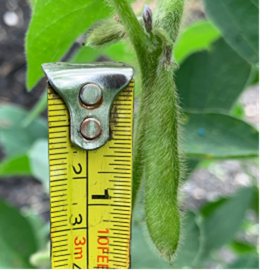 | 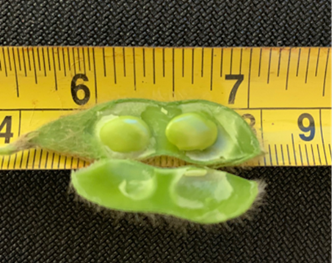 |
Seeds per pod on average are 2.5 seeds per pod. The behind-the-scenes information that people don’t talk about is that in order to fill those pods with more seeds, you need to have enough sunlight so the leaves at that node can photosynthesis efficiently and fill pods. A large part of the energy that is produced at that node is directed to the pods and the seeds at that node. If you string together numerous cloudy days, coupled with defoliating insects (green clover worms, Japanese beetles, thistle caterpillars, grasshoppers) that attack leaves, you can reduce the photosynthetic area and subsequent yield. Insects are not the only thing that defoliates soybean leaves. Wind and hail, in addition to the defoliating leaf diseases such as septoria leaf spot, bacterial blight and a host of others, can also reduce the photosynthetic area and yields.
Seed size or weight of the seeds can have a significant impact on yields. The bigger and heavier seeds are, the fewer seeds are needed to create a bushel of soybeans. Seed size is generally thought to be genetically limited, however, good growing conditions with enough sunlight water and fertility after R5.5 is a factor that can make the seed bigger.
Proper plant nutrition plays an important role in creating pods and seed. Wet soil conditions, especially early in the growing season, allow soybean plants roots not to have to grow as deep to access water and nutrients. Compaction also plays a factor in shallower root development. Plant fertility, or the lack there of, is an aspect that many farmers and agronomists sometimes forget about when thinking about soybean yields. Soybean yields are impacted by which variety is picked and where it is placed, but it is also impacted by fertility. Remember, a 60-bushel soybean crop will remove 50 lbs. (P2O5) of Phosphorus and 78 lbs. (K2O) of Potassium from the soil. If you fertilize for corn and not soybeans, or if you fertilize for corn and soybeans, and your corn crop yielded more than your yield goal, odds are you were short on fertility. If you have soil pH levels that are below 6.2 or above 7.2 you have additional fertility concerns that will affect soybean yields.
Lastly, if you have questions about your soybean yields, talk to your local Dairyland Seed personnel to help discuss yield limiting factors, and what Dairyland soybeans will work best for you and your farms.
Subscribe for more insights delivered straight to your inbox.
 Brian Weller |  Dan Ritter |  Chad Staudinger |  Mark Gibson |  Amanda Goffnett |  Ryan Mueller |