Share:
Corteva Agriscience is unifying its regionally focused seed brands under the Hoegemeyer® brand name. This transition strengthens our position as a reliable seed supplier, supports long-term brand growth and increases operational efficiency to scale and better meet growers’ needs today and in the future. While this is a change for our customers, the benefits they enjoy today working with our regional dealer service model brands will remain the same: access to high-performing genetics through locally proven products, trusted relationships and personalized service. Dairylandseed.com will no longer be available after June 30, 2026.
Learn more about Hoegemeyer.

Refocusing on Soybean Cyst Nematode Management
- The most important management tactic for soybean cyst nematode (SCN) has been breeding and selection of soybean varieties with genetic resistance to SCN.
- The rhg1b gene from PI88788 source of SCN resistance has lost effectiveness for SCN control in many fields, meaning that SCN once again poses a threat to soybean yield that requires grower attention and management.
- SCN testing, rotations with varieties containing different sources of resistance such as Peking, rotation to non-host crops, and nematicide seed treatments are all important tools in a SCN management plan.
SOYBEAN CYST NEMATODE IN NORTH AMERICA
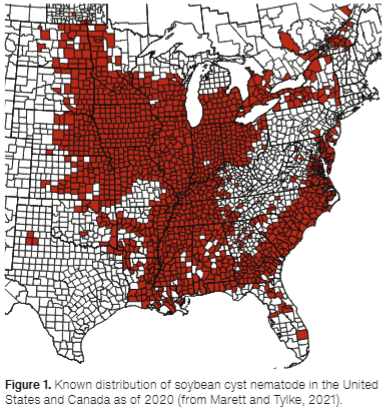
- Soybean cyst nematode (SCN; Heterodera glycines) is a major yield-reducing pest of soybean in North America.
- SCN was likely introduced to the U.S. from Japan. The first report of SCN in the U.S. was in North Carolina in 1954.
- This tiny worm-like parasite has now spread to practically all major soybean production areas of the U.S. and Canada (Figure 1) and is reaching economic levels in more areas.
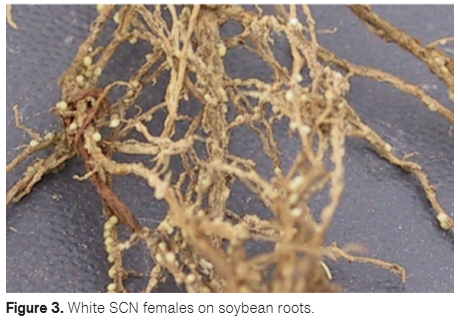
- SCN may reduce soybean yields substantially without inducing obvious symptoms. Studies have shown that in SCN-infested fields, yields can be reduced by over 30 percent without visible above-ground symptoms.
LEADERSHIP IN GENETIC RESISTANCE TO SCN
- The most important management tactic for SCN has been breeding and selection of soybean varieties with genetic resistance to SCN.
- Researchers have identified several soybean lines with the ability to resist nematode reproduction on their roots. Researchers then identify the specific genes causing
- resistance within these diverse soybean lines and breed those specific SCN resistance genes into elite soybean varieties.
- Breeding multiple genes for resistance into a soybean variety can produce more robust protection from SCN.
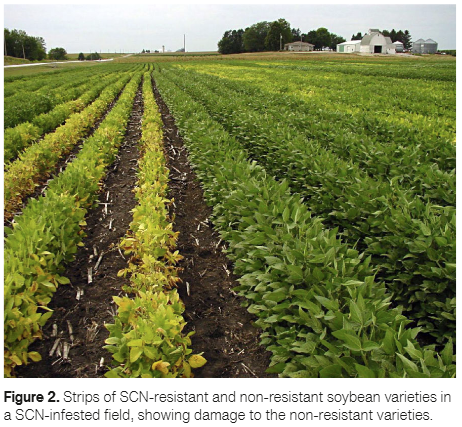
- Many of the soybean varieties across the industry today only contain a single gene for SCN resistance – the rhg1b resistance gene derived from PI88788.
- A smaller number of elite varieties currently use multiple genes for resistance, mostly derived from Peking (PI548402).
- Most current soybean varieties with resistance genes derived from Peking, contain three genes for SCN resistance.
- Other varieties in the industry with resistance derived from Peking may only contain two genes for resistance. Varieties with three genes for resistance from Peking provide a more robust level of control against SCN.
- Continued SCN leadership is a priority as researchers develop soybean varieties with higher yield potential and resistance to SCN. Additional sources of SCN resistance (beyond Peking or PI88788) will be launched in elite varieties in coming years.
SCN HG TYPES
- SCN populations are genetically diverse and have historically been separated into races by their ability to reproduce on soybean tester lines.
- The most commonly used system separated SCN into 16 races.
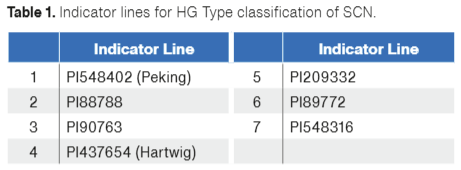
- The most recent classification system, called the HG Type test, has now been widely adopted. The HG Type test is similar to a SCN race test but includes only the seven sources of resistance in available SCN-resistant soybean varieties.
- Results are shown as a percentage, indicating how much the nematode population from a soil sample increased on each of the seven lines.
- The HG Type test indicates which sources of resistance would not be suited for the field being tested. For example, if an HG type contains the number 2, this indicates that PI88788 would not be fully effective source of SCN resistance (Table 1).
DECREASED EFFICACY OF THE RHG1B GENE FROM PI88788
- Beginning in the 1990s, the widespread availability of soybean varieties with PI88788 SCN resistance provided a largely effective management tool for SCN in North America.
- In recent years however, the rhg1b gene from PI88788 has been losing its effectiveness as a SCN management tool.
- Studies in several states have shown that a high percentage of fields have SCN populations with elevated reproduction on the rhg1b gene from PI88788.
- As the SCN HG types in these fields evolve increasing levels of parasitism, SCN populations rise in number and the soybean yield losses increase as well.
- The rhg1b gene from PI88788 source of SCN resistance has lost effectiveness for SCN control in many fields, meaning that SCN once again poses a significant threat to soybean yield that requires grower attention and management.
SCN MANAGEMENT RECOMMENDATIONS
- The SCN Coalition provides the following recommendations for developing a plan to manage SCN (www.thescncoalition.com):
- Test your fields to know your numbers
- Rotate resistant varieties
- Rotate to non-host crops
- Consider using a nematode protectant seed treatment
- Consult your university soybean extension specialist for specific management recommendations for your state.
Test Your Fields
- The first step in developing a SCN management plan is testing fields to determine the presence of SCN and/or the HG type of the population. Soybean specialists now recommend retesting infested fields every six years.
- Sample at the same time of year and following the same crop each time – SCN populations vary during the growing season and in response to host and non-host crops.
- Limit the area represented in a single sample to 10-20 acres to increase accuracy of results.
- Use a soil probe, a small shovel, or a trowel to collect samples. Collect soil to a depth of 6-8 inches in the root zone of plants.
- Collect 10-20 “cores” with the probe, or 10-20 ¼-cup samples with the shovel or trowel. Representative sampling is best achieved by collecting subsamples in a zigzag pattern across the entire sample area.
- Some universities recommend sampling markedly different soil textures separately. Also, areas with different cropping histories should be sampled separately.
- Deposit subsamples in a bucket and mix thoroughly. Place about 2 cups of soil in a plastic bag and label with a permanent marker. Paper bags allow soil to dry excessively and are not recommended for SCN.
- Do not store samples in direct sun or allow them to overheat. Ship as soon as possible to the lab you choose.
Protect Your Yield – Know Your Numbers!
SCN is the #1 yield-robbing pest in soybeans.
Dairyland Seed is offering FREE SCN testing kits this season. Taking advantage of this service puts our AGRONOMY FIRST approach into action — helping you manage pressure before you see it in your yields.
Rotate Resistant Varieties
- It is important to rotate varieties with different resistance genes that provide control of different HG types. This helps prevent SCN populations from increasing on a particular resistance source.
- There is a growing lineup of high yielding, adapted varieties that contain Peking resistance. Farmers should rotate Peking-derived resistant varieties with PI88788-derived resistant varieties across soybean crop years.
- Using varieties in rotation with different genes for SCN resistance will help maintain low SCN levels in these fields. It is best to begin rotating resistance before SCN levels
buildup. - As a leader in SCN breeding, we have used precision molecular breeding methods to identify and isolate the SCN resistance genes found in multiple sources of resistance
and move those specific genes into high yielding adapted varieties. - New soybean varieties with expanded SCN resistance (beyond Peking or PI88788) will be available in the near future.
Rotate to Non-Host Crops
- Corn, alfalfa and small grains are the most common non-host choices for reducing SCN numbers.
- Some SCN will hatch each season, and in the absence of a suitable host like soybean, those SCN will die. This causes a gradual reduction in SCN numbers the more years a non-
host crop is planted. However, SCN persists in the soil for many years, so crop rotation will not eliminate SCN.
Seed Treatments
- Nematicide seed treatments are intended to supplement current SCN management strategies, not replace them.
- The LumiGEN® system offering includes ILEVO ® HL fungicide/ nematicide seed treatment, which has activity against SCN.
- A study including 193 on-farm trial locations found an average yield response of 4.9 bu/acre in high SCN fields when ILEVO fungicide/nematicide seed treatment was added to the standard fungicide and insecticide seed treatment package (O’Bryan and Burnison, 2016).
REFERENCES
Bissonnette, K.M., and G.L. Tylka. 2017. Seed Treatments for Soybean Cyst
Nematode. Iowa State University Extension. Crop 3142. https://store.exten-
sion.iastate.edu/product/Seed-Treatments-for-Soybean-Cyst-Nematode
Mitchum, M.G., and A. Howland. 2018. Distribution, Levels, and HG Types of
SCN Populations in Missouri. Pioneer Agronomy Research Update. https://
www.pioneer.com/home/site/us/pioneer_growingpoint_agronomy/2018/
distribution-levels-scn-pop-missouri/
O’Bryan, K., and M. Burnison. 2016. Performance of Soybean Seed Treatments
Against SDS and SCN in On-Farm Trials. Pioneer Agronomy Research Up-
date. https://www.pioneer.com/home/site/us/pioneer_growingpoint_agron-
omy/2016/soybeans-ILeVO-sds-scn
Tylka, G. 2018. Reflecting on SCN in Iowa Through the Years. Iowa State Uni-
versity Extension Integrated Crop Management News. https://crops.exten-
sion.iastate.edu/cropnews/2018/09/reflecting-scn-iowa-through-years
Tylka, G.L., and C.C. Marett. 2021. Known Distribution of the Soybean Cyst
Nematode, Heterodera glycines, in the United States and Canada in
2020. Plant Health Progress 22:72-74. https://apsjournals.apsnet.org/doi/
full/10.1094/PHP-10-20-0094-BR
Wilson, J. 2018. New Methods Needed to Manage SCN in Soybean. University
of Nebraska-Lincoln Cropwatch. https://cropwatch.unl.edu/2018/new-SCN-
mgmt-methods
Subscribe for more insights delivered straight to your inbox.