Share:
Corteva Agriscience is unifying its regionally focused seed brands under the Hoegemeyer® brand name. This transition strengthens our position as a reliable seed supplier, supports long-term brand growth and increases operational efficiency to scale and better meet growers’ needs today and in the future. While this is a change for our customers, the benefits they enjoy today working with our regional dealer service model brands will remain the same: access to high-performing genetics through locally proven products, trusted relationships and personalized service. Dairylandseed.com will no longer be available after June 30, 2026.
Learn more about Hoegemeyer.

6/3/2025
Late Spring Frost Event
By Dairyland Seed Agronomy Team
On Friday, May 28, a frost event occurred that seemed to affect most of North Dakota and northern Minnesota. On Saturday May 29, another frost event hit areas to the south. If your area was affected by either frost event, try to be patient. Give the plants 3 to 5 days to see how they will recover.
Waiting 3 to 5 days prior to evaluating the extent of the damage will allow a more accurate forecast of plants that will succumb and which will recover. If you find yourself walking fields, pick out a few sentinel plants and place stakes or flags by them. Photograph the day-to-day progress of these plants. This information can provide tangible proof as to how plants are progressing or regressing which will help with the decision making process.
CORN:
In most, but not all instances, final stands and yield of corn are not affected by frost in the 4-leaf growth stage (V4 or collar on fourth leaf) or earlier.
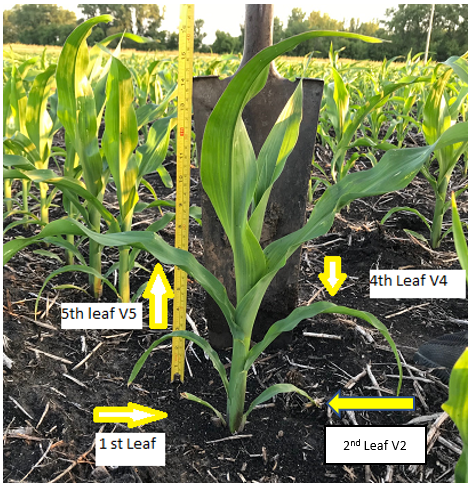
At the 4-leaf growth stage, the growing point is between .5” and 1” from the soil surface and above ground tissue can be frosted, turn gray, wilt, and start to dry and shrivel up, but the plant should be fine. With warmer temperatures, adequate moisture and sunshine, normal growth should occur, and a new leaf should start to poke through. If we are cool and wet after a frost event, the above ground leaf tissue, instead of drying up, may begin to decay or mold. This decay can move down the plant, attack the growing point and eventually kill the plant. In some instances, excess leaf tissue that is tied up can cause similar results.
If the freezing temperatures persist for more than a few hours, the growing point (even though it is below the soil line), may be affected. Lighter or finer textured soils such as sand or peat especially if they are dry, may allow cooler temperatures to penetrate deeper into the soil profile, which may increase the loss of plants.
At the V5 leaf stage, the growing point is at the soil surface and will be above ground as the plant continues to grow. The growing point is somewhat protected from cooler temperatures due to its location in the center of the plant. However, if temperatures are cool enough for long enough, the plant will succumb to these pressures.
To assess the damage to corn plants, wait 3 to 5 days, dig up a few affected corn plants, root, and all. Cut open the corn plant to find the growing point. Remember on a V4 corn plant the growing point is .5”-1” below the soil surface. A V3 corn plant growing point will be 1” or more below the soil surface.
- If we are lucky and the growing point is firm and has a green or greenish yellow color, we should be okay.
- If the growing point is gray, tan, or brown, this indicates that the growing point is injured and odds are, the plant will not survive.
SOYBEAN:
Once the cotyledon or seed leaves emerge from the soil surface the growing point of the soybean is above ground. As a rule, soybeans can withstand cooler temperatures than corn without significant damage. This is in part due to the leaf tissue of the plant being closer to the soil line and heat from the soil as well as the structure of the leaves and number of leaves per foot of row keeping the heat closer to the plant. Much like corn, lighter or finer texted soils such as sand or peat especially if they are dry, may allow the cooler temperatures to penetrate deeper allowing more area of the soil to cool, thus killing the plant.
All the leaf tissue on a soybean plant may be injured, and turn brown or black, but the plant can still recover. Axillary buds which normally are semi dormant if the growing point at the top of the plant is alive, will start to become more active and grow. Axillary buds are found near the attachment area of all leaves (cotyledon, unifoliate and trifoliate) and if these axillary buds are not damaged, odds are the soybean plant will recover.
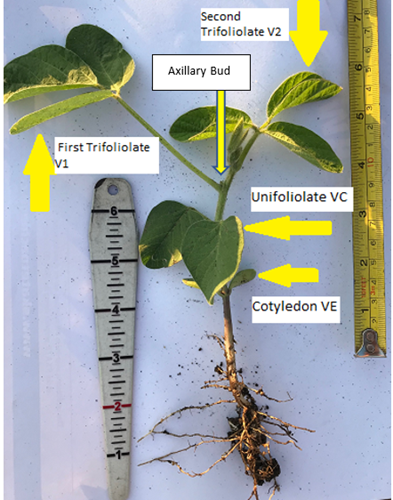
To assess frost damage to soybeans, wait 3-5 days, examine the leaf tissue paying close attention to where the axillary buds attach.
- If you have green growth coming from those axillary buds the plant should be ok, especially if you still have some green left in the cotyledon leaves.
- If where the axillary buds attach, the surface is dark green to black in color, the plant is probably dead. Also, if cotyledons are entirely brown, or the area below the cotyledon (which is called the hypocotyl) is tan or brown and is starting to shrivel up, odds are the plant is dead.
As was stated previously, be patient and wait 3 to 5 days after the frost event to view your fields to inspect plants, this will give you a better idea of plants that will survive and those that will not.
If you have further questions, contact your local Dairyland Seed District Sales Manager or Regional Agronomist.
Subscribe for more insights delivered straight to your inbox.
 Brian Weller |  Dan Ritter |  Chad Staudinger |  Mark Gibson |  Amanda Goffnett |  Ryan Mueller |