Share:
Corteva Agriscience is unifying its regionally focused seed brands under the Hoegemeyer® brand name. This transition strengthens our position as a reliable seed supplier, supports long-term brand growth and increases operational efficiency to scale and better meet growers’ needs today and in the future. While this is a change for our customers, the benefits they enjoy today working with our regional dealer service model brands will remain the same: access to high-performing genetics through locally proven products, trusted relationships and personalized service. Dairylandseed.com will no longer be available after June 30, 2026.
Learn more about Hoegemeyer.

8/27/2025
Black Layer R6 Physiological Maturity
By Dairyland Seed Agronomy Team
As the corn crop across our footprint is in the grain fill or reproductive stages, a common topic of conversation is when will the corn mature or when will harvest begin. Some areas may have the opportunity to capitalize on early delivery of grain corn. Understanding the timeline between tassel and physiological maturity can help determine if early harvest may be a viable option for your operation.
- Corn matures approximately 55 to 60 days after tasseling. There are many stages in the maturation process. Knowing when tasseling occurs can help estimate when corn will mature, so be sure to note tasseling dates.
- The progression of the milk line and black layer development are important to irrigation scheduling and application of preharvest herbicides. Yield could be reduced if you terminate irrigation or apply a harvest aid too early.
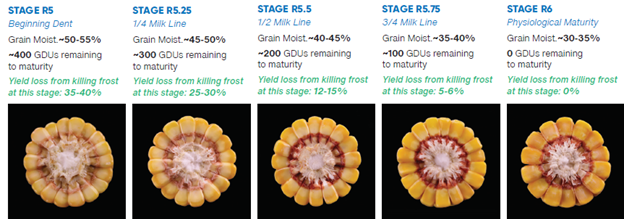
- It takes approximately 20 days for the milk line to progress from the tip of the kernel to the base. For example, if the milk line is halfway down the kernels, it will take another 10 days to reach physiological maturity, so the field needs continued irrigation and a delay in harvest data application for 10 or more days.
Physiological maturity or black layer forms when the hard starch layer reaches the kernel base, signifying physiological maturity. The black layer cuts off water and dry matter transfer into the kernel. At this stage, kernels have moisture content of about 30 to 35 percent.
Kernels accumulate dry matter from the day of pollination (R1) to physiological maturity (R6 this is often referred to as Black Layer). The table below tracks reproductive growth stages from days after tassel/silking and the approximate moisture at that stage.
Growth Stage |
| Days After Silking | Approximate Moisture |
Tassel / Silking | R1 | 0 |
|
Blister | R2 | 10-14 days | 85% |
Milk | R3 | 18-22 days | 80% |
Dough | R4 | 24-28 days | 70% |
Dent | R5 | 35-42 days | 60% |
Black layer | R6 | 55-65 days | 30-35% |
Dry Down following Maturity
- Individual kernel drying occurring after black layer is solely due to evaporative moisture loss.
- Corn drydown rate is linked to Growing Degree Unit (GDU) accumulation.
- Generally, corn drying from 30% down to 25% moisture needs around 30 GDUs per point of moisture.
- Drying from 25% to 20% needs around 45 GDUs per point of moisture.
- GDU accumulation and dry down are the greatest typically during the earlier and normally warmer part of the harvest season and decline as the weather gets colder.
- Constant or steady wind coupled with lower humidity levels also will impact on how fast kernels will dry. Conversely, corn may not dry at all on days with high humidity or rainfall.
- Corn can drop one point of moisture per day under favorable drying conditions.
Hybrid Attributes that Affect Kernel Dry Down
- Husk Leaf Coverage - Leaf number, thickness and or tightness will negatively impact kernel dry down rates.
- Husk Leaf Senescence – The quicker these leaves die, the faster the grain will dry down.
- Ear Angle – Upright ears are more prone to capture moisture in the husks, which slows dry down.
- Kernel Pericarp Characteristics – Thinner or more permeable pericarp layers are associated with a faster drydown rates.
Subscribe for more insights delivered straight to your inbox.
 Brian Weller |  Dan Ritter |  Chad Staudinger |  Mark Gibson |  Amanda Goffnett |  Ryan Mueller |