Share:
Corteva Agriscience is unifying its regionally focused seed brands under the Hoegemeyer® brand name. This transition strengthens our position as a reliable seed supplier, supports long-term brand growth and increases operational efficiency to scale and better meet growers’ needs today and in the future. While this is a change for our customers, the benefits they enjoy today working with our regional dealer service model brands will remain the same: access to high-performing genetics through locally proven products, trusted relationships and personalized service. Dairylandseed.com will no longer be available after June 30, 2026.
Learn more about Hoegemeyer.

6/25/2025
Understanding the Causes of Yellow Soybeans
By Dairyland Seed Agronomy Team
Over the last week to ten days numerous calls and discussions have been had about “Why are my soybeans yellow or ghostbuster slime greenish yellow?”. The standard agronomist answer of “it depends” rings very true in this instance. In areas with high or higher pH levels (≥7.0) Iron Deficiency Chlorosis (IDC) is always the first thought, and at some level a player in the cause of these conditions. However, it is not the only cause.
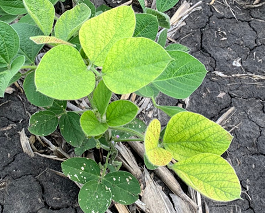
The standard agronomist answer of “it depends” rings very true in this instance. In areas with high or higher pH levels (≥7.0) Iron Deficiency Chlorosis (IDC) is always the first thought, and at some level a player in the cause of these conditions. However, it is not the only cause. Listed below are other potential factors that can cause yellow soybeans or increase the severity of yellow soybeans.
Wet Soils: Soybeans and legumes in general prefer drier feet versus wetter feet the opposite of cattails and cottonwoods. When soils are wet, there is limited air exchange with the atmosphere which causes a buildup of carbon dioxide in the soil. Roots and soil microbes produce carbon dioxide through respiration. The amount of bicarbonate in the soil is proportional to the amount of carbon dioxide. As carbon dioxide increases, so does bicarbonate. This increase will rapidly neutralize the acidity around the soybean root. Research has shown that soil moisture can increase IDC severity, especially at low temperatures. The amount of bicarbonate in the soil correlates with IDC in soybean in the field; thus the more bicarbonate in the soil, the more IDC will occur. In wet soil conditions, it may be useful to consider cultivation to speed the release of carbon dioxide from the soil.
Water Movement: We also typically see yellow or lighter colored soybean leaves in areas where water has moved through or ponded. These are areas where calcium carbonates and salts may “fall out” and collect.
Cold/Cooler Soils: Soybeans prefer soils greater than 60°F. They can grow in soils cooler than that, however, they do prefer warmer soils. When soils are cooler, the amount of biological activity is lessened or slowed. Soybeans nodulation is a byproduct of biological activity and starts at V2 (two trifoliate leaves). If it is cold and wet at this time, your nodule production is slow or very limited. Cooler soils (≤65°F) also inhibit bacteria that allow phosphorus to become available to the plant.
High pH: As pH increases, iron becomes less available to the plant. You can see shells of snails etc. Soybean roots excrete an acid, as well as other products from their roots, that change insoluble iron to soluble iron. If the calcium carbonate is very fine, and at high levels, the roots cannot neutralize that amount of free calcium.
Manure or Decaying Organic Matter: Decaying organic matter, whether it is from crop residues or manures, adds to the amount of carbon dioxide in the soil. The microbes breaking the organic matter down release carbon dioxide as part of the process. Wet soils will limit the diffusion of the carbon dioxide out of the soil. This increases the risk for bicarbonate buildup in the soil and therefore increases the severity of IDC.
Salinity/High Soluble Salts in Soil: 51 to over 1.0 increases likelihood of seeing more IDC areas.
Cyst Nematodes: CN can also allow other pathogens to enter the root (SDS, BSR, and others as well as higher soybean aphid numbers). SCN infections seem to be more severe in high pH soils. You can also see increased nutrient deficiencies. One of the most noticeable issues in high pH soils is iron deficiency chlorosis (IDC), along with potassium (K) deficiency. This makes sense, as openings in the roots can create leaks that allow water and nutrient-rich fluids to escape
Nitrate Levels: Due to drier soil conditions and higher soil temperatures mid to late summer 2024, we had higher than normal soil nitrate levels.
Soil nitrate in the field can increase the chlorosis intensity. Field and greenhouse studies have shown that the addition of nitrate increases the severity of chlorosis in soybean When a plant root takes up nitrate, it must exchange with a bicarbonate ion. In addition, the plant needs to convert nitrate to ammonium within the leaves. This increases pH in leaf sap and decreases the rate of reduction of Fe III to Fe II that is necessary for leaf cells to have usable Fe. Iron in leaflets can be greater in the chlorotic plants than non-chlorotic plants because of an accumulation of iron in the leaves and the plant's inability to reduce the iron III into an available form. Both cases increase IDC.
Differences in soil nitrate may explain why we often see less chlorosis in the wheel tracks of the secondary tillage in a soybean field, The soil under the tractor wheels is more compacted. This causes the compacted area to be more anaerobic (low air), but not low enough to reduce much Fe III (insoluble) to Fe II (soluble). These slightly anaerobic soil conditions can cause denitrification of nitrate to N2, reducing the amount of nitrate in the soil and the amount of IDC.
Nitrogen Deficiency: If a plant is slow or not actively nodulating, we may see evidence of this by yellow leaves on plants.
Herbicide: Previous growing seasons’ herbicide applications with low rainfall and high temperature increase the likelihood of having extra strength residual or carry over from a previous seasons herbicide program.
Another potential cause of yellow soybeans are higher labeled application rates, of a soil applied herbicide, than the Organic Matter (O.M.) or Cation Exchange Capacity can handle. This is accentuated with cooler, cloudy days.
Other herbicide factors are in-season post emerge herbicide applications. Historically, we have seen a phenomenon called “yellow flash” after a high rate of a post emerge herbicide(s) application even in soybeans tolerant to that herbicide. This is again more prevalent in cooler, cloudier days.
Root Development: If roots are twisted or hindered by compaction, this may reduce the plant’s ability to access water and nutrients.
Soybean Seeding Rates: The recent trend of lower seeding rates increases the stress (particularly IDC and Salinity) that an individual soybean plant needs to overcome. (The solution to pollution is dilution.)
These factors alone or in combination can be the culprit(s) in our yellow soybean trend. As always if you have questions about this or other agronomic questions, contact your Dairyland Seed Agronomist.
Subscribe for more insights delivered straight to your inbox.
 Brian Weller |  Dan Ritter |  Chad Staudinger |  Mark Gibson |  Amanda Goffnett |  Ryan Mueller |