Share:
Corteva Agriscience is unifying its regionally focused seed brands under the Hoegemeyer® brand name. This transition strengthens our position as a reliable seed supplier, supports long-term brand growth and increases operational efficiency to scale and better meet growers’ needs today and in the future. While this is a change for our customers, the benefits they enjoy today working with our regional dealer service model brands will remain the same: access to high-performing genetics through locally proven products, trusted relationships and personalized service. Dairylandseed.com will no longer be available after June 30, 2026.
Learn more about Hoegemeyer.

9/18/2025
Stalk Strength and the Importance of Scheduling Harvest Order
By Dairyland Seed Agronomy Team
It’s not uncommon to see stalk strength start to diminish late season but this year’s growing conditions likely sped up the process. Cool temperatures coupled with wet conditions in the spring favor infection by soil-borne pathogens early in the season. Although infection takes place early in the spring, symptoms don’t typically appear until closer to maturity. Symptoms are much more likely to show up if the plant experiences cool and wet conditions early, followed by hot and dry conditions later in the season.
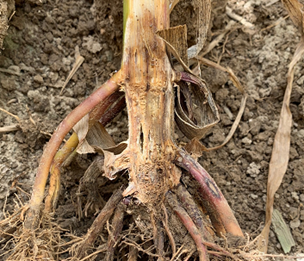
Plants that experience heat and drought stress during the growing conditions are likely to see stalk cannibalization. The corn plant will steal carbohydrates from the stalk and use that to fill kernels in the ear, leaving the stalk tissue depleted. Stalks that have been cannibalized decline and lose their ability to fight off pathogens. Soil borne pathogens can then invade and colonize the plant much easier, resulting in crown and/or stalk rots. Plants infected with crown or stalk rots are at risk for lodging. Usually, we see more wind events in October and November which can also impact standability.
The disease that is very prevalent this year is Fusarium. The photo above shows a corn plant with Fusarium that has both crown and stalk rot.
Other common diseases we could see are:
Anthracnose, which is mainly thought of as top dieback disease, but the more advanced stages of the disease show black lesions on the stalk
Physoderma Brown Spot, which in most instances is a leaf disease but can cause stalks rots that is associated with a brown or black ring around one or several of the lower nodes on the stalk
Red Root Rot (Phoma terrestris) can cause symptoms similar to crown rot and may appear in the same fields. Deep red to purple discoloration of crown and root tissues are associated with red root rot.
Diplodia Stalk Rot can be found in both the stalk and the ear or kernels with stalks and kernels a rough texture it tends to cause affected tissue to have black fungal formations on it
Gibberella Stalk Rot which is very similar in appearance to Fusairum and is tough to discern which one it is due to both cause pink/red or salmon colors inside the stalk
The procedure that I follow to check fields is to review which fields were planted in “less than ideal conditions” as well shorter day hybrids and scout them first. I will then walk across a portion of the field and perform Pinch, Push, Shove and Slash tests along the way.
- Pinch the stalks 4-8 inches off the soil level. If it collapses, you have a crown or stalk rot, or both.
- Push the stalks so the top of the plant touches the row across from it. If it buckles under that pressure, odds are you have a stalk rot.
- Shove a few stalks down the row and see how much pressure it takes to break them. The less pressure it takes to break them increases the probability of standability issues.
- Slash or cut the stalk 10-12” above the soil line with a sharp knife down to or through the roots, (remember to be safe and cut away from yourself) I generally will dig the plant first. The crown and stalk should be a white or creamy color, (the photo below shows a healthy stalk and root on the left, whereas the stalk and root on the right is not healthy) if it is not that plant has a crown or stalk rot
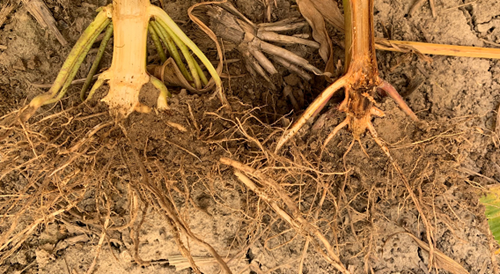
The more plants that fail these tests increases the odds that you will need to harvest that field early or move it up in the harvest schedule. Remember that these affected plants will be more susceptible to wind damage the longer the harvest window gets.
Having and following a harvest order decreases the likelihood of harvesting down corn and increases the likelihood of capturing more yield but also having a safer and less stressful harvest season.
Subscribe for more insights delivered straight to your inbox.
 Brian Weller |  Dan Ritter |  Chad Staudinger |  Mark Gibson |  Amanda Goffnett |  Ryan Mueller |