Share:
Corteva Agriscience is unifying its regionally focused seed brands under the Hoegemeyer® brand name. This transition strengthens our position as a reliable seed supplier, supports long-term brand growth and increases operational efficiency to scale and better meet growers’ needs today and in the future. While this is a change for our customers, the benefits they enjoy today working with our regional dealer service model brands will remain the same: access to high-performing genetics through locally proven products, trusted relationships and personalized service. Dairylandseed.com will no longer be available after June 30, 2026.
Learn more about Hoegemeyer.

7/9/2025
Soybean Flowering and White Mold
By Dairyland Seed Agronomy Team
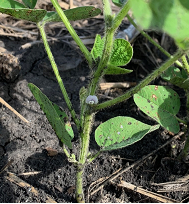
Most soybeans fields around the area are entering the flowering stages. Soybean plants can start the flowering process from V2 -V8 (2nd to 8th Trifoliolate), and with early planting dates can start flowering prior to Summer Solstice. Other factors such as drought stress can induce plants into flowering. Conversely, soybeans that are planted early and have good fertility are also more prone to flowering early. Once a soybean plant starts to flower, it is in the Reproductive phase or R1 which is Beginning Bloom when one open flower on any node on the main stem, which is shown below.
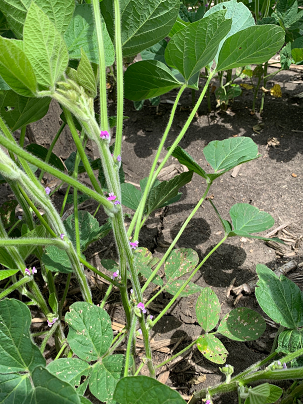
The photo above shows a soybean plant in the R2 growth stage which is Full Bloom when an open flower is on one of the two uppermost nodes on the main stem. Peak flowering occurs at Beginning Pod development (R3), with flowering continuing until Beginning Seed (R5) or shortly thereafter. Soybean plants will flower and put on vegetative growth at the same time. Not every flower or blossom will produce a pod, in fact, it is not unusual for soybeans to abort 60 to 70 percent of their flowers. The issue with aborted flowers besides reduced yield potential, is that it provides an opening for a fungus Sclerotinia sclerotiorum (which causes white mold) to enter the plant.
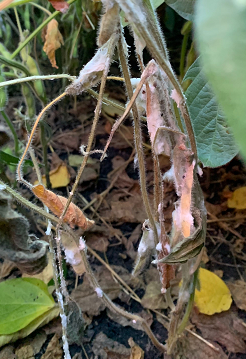
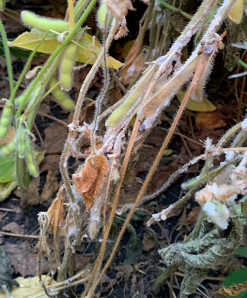
The white mold fungus, Sclerotinia sclerotiorum, primarily infects the soybeans through senescing flowers around the R1-R3 (first flower – beginning pod) stage. Conditions that usually create favorable conditions for white mold are lower than normal temperatures (below 85°F) and above average precipitation or high humidity around the time of flowering. Symptoms don’t usually appear until the R4-R6 (full pod – full seed) growth stages. Foliar symptoms are interveinal coloring of grey-green and can resemble other soybean diseases such as brown stem rot or stem canker. Fluffy white mycelium growth can be found on the stems near the nodes. Leaves of infected plants eventually die but remain attached to the stem.
 |  |
Areas to watch
- Fields with a history of white mold will be at a higher risk for developing white mold again due to the increased inoculum. It is also important to note that the sclerotia (small, black overwintering structures) can persist in the soil for several years.
- Highly productive fields tend to produce excessive vegetative growth which restricts airflow through the canopy and therefore is more favorable for white mold.
- Narrow row spacing and high populations will also contribute to restricted air flow through the canopy and should be monitored.
- Fields planted to soybean varieties with low white mold tolerance are at a higher risk for developing white mold.
If you have fields that have a history of white mold (SWM) that are in soybeans this year, and are looking at applying control measures, many fungicides such as Viatude®, recommend applications at R1 followed by another application at R3. This tends to make sense in that most fungicides do not move into new growth, and an additional application at R3 would provide supplementary coverage to new flowers and vegetative growth on the plant. Other fungicide options can be found on the Fungicide Efficacy Chart from Crop Protection Network at https://cropprotectionnetwork.org/publications/fungicide-efficacy-for-control-of-soybean-foliar-diseases.
Another factor that starts coming in to play when soybeans start flowering is, many herbicide labels place restrictions on application timing for crop safety, starting when soybeans reach the Reproductive or R stages. These restrictions are not always about crop safety; they may also have environmental and or rotational crop concerns for following years.
If you have any questions regarding this or other Agronomic topics, contact your Dairyland Seed Regional Agronomist.
Subscribe for more insights delivered straight to your inbox.
 Brian Weller |  Dan Ritter |  Chad Staudinger |  Mark Gibson |  Amanda Goffnett |  Ryan Mueller |