Share:
Corteva Agriscience is unifying its regionally focused seed brands under the Hoegemeyer® brand name. This transition strengthens our position as a reliable seed supplier, supports long-term brand growth and increases operational efficiency to scale and better meet growers’ needs today and in the future. While this is a change for our customers, the benefits they enjoy today working with our regional dealer service model brands will remain the same: access to high-performing genetics through locally proven products, trusted relationships and personalized service. Dairylandseed.com will no longer be available after June 30, 2026.
Learn more about Hoegemeyer.

8/4/2025
Soybean Flowering and Reproductive Stage
By Dairyland Seed Agronomy Team
Soybean Flowering and Reproductive Stages
Soybean flowering can occur from the V2 (second trifoliate), which is the third node to V5 (fifth trifoliate). Once soybean plants start the flowering process, they are in the reproductive phase (R), and all growth phases from here on out will be listed in the R stage (example R1, R2, etc....) Soybeans will continue to put on vegetative growth during the reproductive stage and some Agronomists will list both the vegetative and reproductive stages V7 or R1 for growth stages.
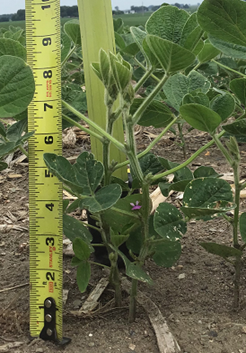
(The plant shown in the photo above is in the R1 of beginning bloom stage.)
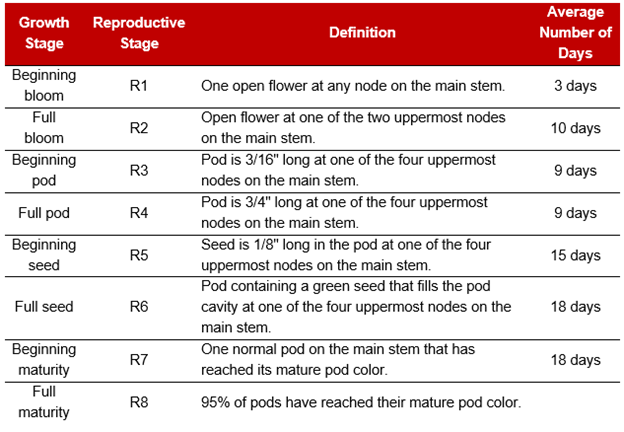
Soybeans can abort up to 80% of the flowers that they produce. This may be advantageous because if the first few flowers or blooms do not pod, the plant will start podding higher up the stem and off the ground making combining easier. Flower height is also a concern for beans planted just prior to, or shortly after the summer solstice. An example of this would be replanted or double cropped soybeans after winter wheat or peas.
Nutrient uptake technically starts at V2 when soybean plants start to add nodules to their roots. After, it is infected with the soil borne Rhizobium japonicum bacteria. This bacterium causes the nodules to start fixing their own nitrogen. The plant does this by taking in non-available nitrogen (N2) in the air, and the bacteria in the nodules converts it to a nitrogen product the plant uses. Nodules will continue to form on the soybean root shortly after R5 (beginning seed) to R6 (full seed).
Less mobile nutrients like P and K are being taken up by the root system, which is growing 0.25 to 0.75 inches per day. Once a soybean plant enters the reproductive phase, the plant’s nutrient uptake increases dramatically. Applying micronutrients during the early to mid-reproductive growth phase is thought to be akin to someone grabbing a mid-morning snack or a cup of coffee; it jumpstarts the system to be more productive.
This nutrient demand will peak shortly after R5.5, with redistribution of the remaining collected nutrients being moved to the seed crop from R5.5 to R8.
As always, if you have questions regarding this or any other agronomic topic contact your Dairyland Seed DSM or regional agronomist.
Subscribe for more insights delivered straight to your inbox.
 Brian Weller |  Dan Ritter |  Chad Staudinger |  Mark Gibson |  Amanda Goffnett |  Ryan Mueller |