Share:
Corteva Agriscience is unifying its regionally focused seed brands under the Hoegemeyer® brand name. This transition strengthens our position as a reliable seed supplier, supports long-term brand growth and increases operational efficiency to scale and better meet growers’ needs today and in the future. While this is a change for our customers, the benefits they enjoy today working with our regional dealer service model brands will remain the same: access to high-performing genetics through locally proven products, trusted relationships and personalized service. Dairylandseed.com will no longer be available after June 30, 2026.
Learn more about Hoegemeyer.

6/25/2025
Glitter Bugs, Lightning Bugs, Fireflies and CRW

By Dairyland Seed Agronomy Team
It seems like yesterday we were planning what plots to plant and delivering seed. Now it is a week from Independence Day. In northwest Indiana lightning bugs have been sighted at least two weeks ago. What does that have to do with agronomy? It just so happens that corn rootworm larvae tend to hatch right around the same time lightning bugs start to show up.
Well folks it seems like yesterday we were planning what plots to plant and delivering seed. Now it is a week from Independence Day. In northwest Indiana lightning bugs have been sighted at least two weeks ago. What does that have to do with agronomy? It just so happens that corn rootworm larvae tend to hatch right around the same time lightning bugs start to show up. It is an interesting manner to know what’s happening in the corn field without braving to 95-degree heat. Iowa State University reported hatch as early as June 9 this year.
Corn Rootworm (CRW) Larvae: If you are using non-traited or above ground only insect protection, and in continuous corn or in a traditionally heavy CRW area, the next few weeks are a suitable time to begin looking for feeding.
We have already observed fireflies or lightning bugs. What does that have to do with CRW? Typically, these two insects have similar timing. When lightning bugs (Photinus) begin emerging, CRW larvae begin hatching. And when they hatch, they want to get a meal.
Fully traited (Qrome® and Vorceed®) corn fields in rotational situations are of lower priority in scouting. Vorceed® is the new enhanced CRW protected corn that adds the traits of Qrome® in addition to RNAi. Other enhanced value-added traits include Enlist® and FOP herbicide tolerance. For a more detailed discussion on the features and benefits of Vorceed® or PowerCore® Enlist® corn products, initiate a call to your trusted Dairyland Seed representative.
Those fields with no CRW traits (AM and PowerCore® Enlist®), or in a long-term corn rotation, should be a higher priority. It is a good idea to check all fields as good stewardship management. Digging, transporting, and washing roots is the standard procedure. (It’s about as fun as putting up small square bales of red clover hay!) In conventional corn, tolerable levels tend to be eight rootworm larvae or less when washing roots.
Corn Rootworm Larval Stage
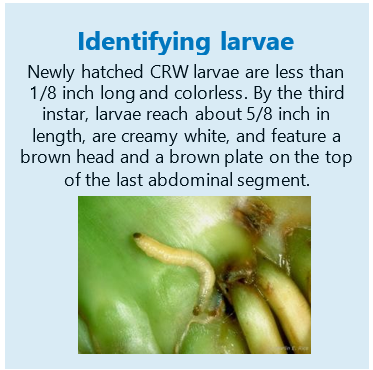
- Newly hatched larvae are attracted by CO2 released from corn roots and can move up to 1.5 feet (0.46 m) in the soil to feed
- Peak feeding occurs from early to mid-July in most Corn Belt regions.
- Soil saturation after hatch can reduce larvae survival.
- Knowing the timing of peak corn rootworm egg hatch helps determine the best window to scout for larvae and evaluate root injury.
- Scout fields for larvae and root injury 3-4 weeks after peak egg hatch.
- Consult with your field agronomist to evaluate management strategies.
The biggest concern of root feeding is a lack of root volume to support the plant with adequate nutrients and water. The other concern is to physically support the plant. Yet another concern is that as the season progresses, high populations of adults can be a cause of significant silk feeding.
Identifying Adults
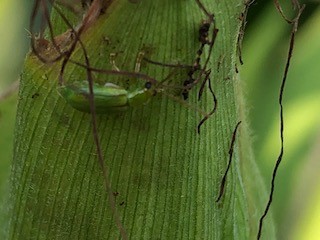
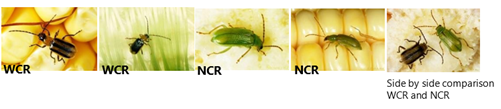
Two main species, Western Corn Rootworm (WCR) and Northern Corn Rootworm (NCR), cause most CRW-related damage in the Corn Belt. WCR have yellow wing covers with black strips or may appear completely black while NCR adults are yellowish to green.
Subscribe for more insights delivered straight to your inbox.
 Brian Weller |  Dan Ritter |  Chad Staudinger |  Mark Gibson |  Amanda Goffnett |  Ryan Mueller |