Share:
Corteva Agriscience is unifying its regionally focused seed brands under the Hoegemeyer® brand name. This transition strengthens our position as a reliable seed supplier, supports long-term brand growth and increases operational efficiency to scale and better meet growers’ needs today and in the future. While this is a change for our customers, the benefits they enjoy today working with our regional dealer service model brands will remain the same: access to high-performing genetics through locally proven products, trusted relationships and personalized service. Dairylandseed.com will no longer be available after June 30, 2026.
Learn more about Hoegemeyer.

7/9/2025
Entering Pollination Phase
By Dairyland Seed Agronomy Team
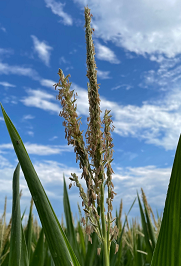
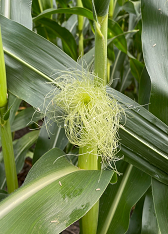
For most of the Dairyland Seed trade territory, our corn crop will soon be close to Tasseling (VT) and Silking (R1 growth stage). Once a plant shoots silks and tassels, it is the start of the reproductive (R) stage of the plant. Some areas may be slightly past that and at Blister (which is the R2 growth stage) when the kernels are white in color and the endosperm or the starch is clear in color.
 |  |
In good growing conditions, silks can and do emerge from the cobs prior to tassel emergence. (As an aside, hybrids or genetic families that perform better in drier environments tend to shoot silks sooner than others). It is not unusual for silks to emerge a day or two prior to tassels and vice versa, where tassels and subsequent pollen from those tassels is out prior to the silks. In droughty conditions, corn plants can shoot the tassel out with the silks not emerging right away or, when they do, the tassel has shed most of its pollen. This leads to poor pollination with few kernels on the ear and reduced yield.
Silks emerge from the husk with the silks from the base (butt) of the ear first and the ear tip silks are the last to emerge. In the first few days of silk emergence, silks can grow up to 1.5 inches per day but will gradually slow down and stop shortly after the pollen from the tassel is captured on the silk. Silks will continue to grow for 7 to 10 days or until pollen is detected. If you notice extremely longs silks on an ear, this can be a sign that the ear did not pollinate correctly. On the other hand, if you have silk being clipped by Japanese Beetle, Corn Rootworm Beetles or other insects, this will not allow pollen enough silking area to land on and start the fertilization process. Due to their high-water content, silks are very sensitive to moisture levels in the plant. Heavy morning dews or moisture prior to and during pollination keeps these silks healthy. Conversely, hot, and dry conditions with high winds are not good for silks.
Tassel emergence marks the end of vegetative growth which means that within a day or two of the tassels emerging, the plant will have reached its total above and below ground growth. Tassels emerging also signifies that within a day or two we will start to see pollen falling from these tassels. Pollen normally sheds from the middle portion of the tassel first and will work its way up and down the tassel this is normally takes place within 7 to14 days.
Pollen, unlike silks, prefers hot and dry conditions. Typically, cool humid conditions delay the shedding of pollen from the tassel and pollen is not shed during rain events or wet tassels. Most pollen sheds take place mainly during mid-morning hours with another shedding event taking place in the late afternoon or early evening as temperatures cool. Pollen shed slows if temperatures exceed 86°F and heat of 100°F or more can kill pollen.
However, as previously stated, pollen is shed from various parts of the tassel over a 7 to 14 day of timeframe. If by chance, we have a few days when pollen shed is reduced or pollen is terminated due to temperatures, we should be able to shed enough pollen to hit the silks and fertilize the ovules which, when successful, turn into kernels. If the pollen is unsuccessful in catching onto the silks, and fertilization does not take place, this silk will stay attached to that ovule for a period of time. Whereas the fertilized kernels will not have a silk attached.
If you have questions regarding this or other agronomic concerns, reach out to you Dairyland Seed DSM or Regional Agronomist.
Subscribe for more insights delivered straight to your inbox.
 Brian Weller |  Dan Ritter |  Chad Staudinger |  Mark Gibson |  Amanda Goffnett |  Ryan Mueller |