Share:
Corteva Agriscience is unifying its regionally focused seed brands under the Hoegemeyer® brand name. This transition strengthens our position as a reliable seed supplier, supports long-term brand growth and increases operational efficiency to scale and better meet growers’ needs today and in the future. While this is a change for our customers, the benefits they enjoy today working with our regional dealer service model brands will remain the same: access to high-performing genetics through locally proven products, trusted relationships and personalized service. Dairylandseed.com will no longer be available after June 30, 2026.
Learn more about Hoegemeyer.

8/13/2025
Corn Silage Considerations for 2025 – Three Key Questions
By Dairyland Seed Agronomy Team
Now that wheat harvest is mostly complete, and the corn crop is pollinated and filling out ears, it is time for our dairy/cattle producers to prepare for an important harvest. Corn silage is the dominant forage fed on most dairy farms, often accounting for 70% or more of the forage portion of modern diets. With this high inclusion rate, producers need to grow, harvest, and store more tons of corn silage per animal than they did in past decades.
What makes corn silage harvest so important? The resulting product plays a significant role in the level of milk or beef production a farm can achieve, as well as the cost of the total ration fed to the animals...for an entire year! TIMING IS EVERYTHING! The value of this high energy crop depends on proper fermentation, which affects nutrient availability and preservability of the feed produced. The largest contributing factor to proper fermentation is harvesting the silage at the proper whole plant moisture content. The proper moisture content depends on the type of storage structure and has remained consistent for several decades. (See Table 1) Depending on weather conditions, the window to harvest corn silage at the proper moisture is very narrow compared to other crops. If you miss it by a few days, or jump the gun and harvest too early, it impacts a full year of production and profitability.
What makes 2025 different? Although there are a distinct set of challenges each year, 2025 has been a good growing season in terms of planting dates, rainfall, growing degree units, and disease & insect pressure. In most areas, the corn crop looks particularly good and consistent. This is especially true when compared to 2024, which was a challenging growing season that produced a corn crop that was highly variable. Knowing that we are looking at a corn crop with high yield potential and consistency, it is important for silage producers to consider these three key questions now.
What yield do I expect to achieve compared to an average year? This cannot be answered at 60 mph through a truck window! Please make sure that you or someone is walking your fields and getting a good estimate of the average tons per acre expected. Although there is opportunity to influence yield through kernel fill yet this season, most other yield factors are already determined. Once an estimate is achieved, look at your inventory and run some scenarios. Having a plan for best case/worse case scenarios can help you avoid surprises at harvest time. It also allows you to explore options, such as extra storage space if needed, designating fields for grain that were initially intended for silage, or adjusting your cutting height based on inventory needs.
How will I achieve the proper whole plant moisture? Discuss your goal with your management team and make sure everyone understands it! This includes custom harvesters. One factor in 2025 that may present a challenge is that almost all corn was planted in a 7 to 14 day window, so many acres will be reaching optimum moisture at the same time. A good way to check moisture content is to select a representation of plants from a field, grind a sample, and use a lab or Koster type of tester to determine the results. If you have your own harvesting equipment, taking field length samples will be the best way to determine actual whole plant moisture content. One advantage to using a lab is you also get an idea of the forage quality before harvest. It is very rare to hear of cases in which silage was harvested too wet. So, plan to begin harvest on the higher end of your moisture range so that your average falls near your goal. Cutting height can also influence your moisture content. The lower portion of the corn stalk holds more water than other plant parts, so raising your cutting height can lower the moisture content in silage. For those utilizing custom harvesters, you will need to have effective communication and work together to ensure your goals are achieved.
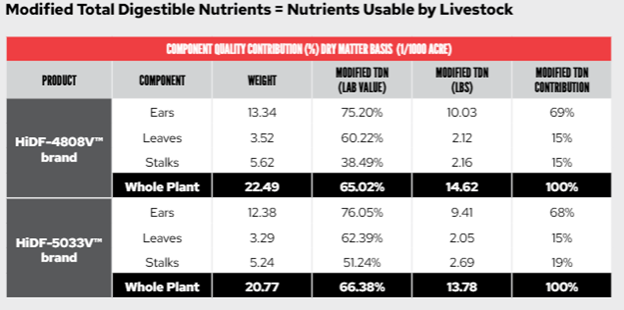
How can I maximize forage quality in 2025? This growing season presents us with a classic situation in which yield and quality tend to have an inverse relationship. Although the yield potential and consistency of the crop point to favorable yield conditions and good starch content, this could impact forage quality in a negative way regarding fiber digestibility. We had a cool start to the growing season shortly after planting, but since then, temperatures have been above normal. We’ve rapidly accumulated growing degree units. When corn plants grow rapidly, they tend to produce a greater amount of lignin, which can reduce fiber digestibility. The silage component study from our 2024 Product Agronomy Research program helped confirm that the leaves and ear contribute about 85% of the total digestible nutrients available in a corn plant. So again, there is an opportunity to adjust cutting height to improve forage quality. This option is also more applicable in years when harvesting the entire plant may not be necessary to achieve inventory goals. The best option is to know your own situation, spend time sampling and analyzing the crop in the field before and during harvest, and then make adjustments to help meet your quality/yield goals.
Table 1. Recommended moisture content (%) for corn stored in various types of storage structures. | |
Upright oxygen limiting silos | 50-60 |
Upright concrete stave silos | 62-67 |
Bag silos | 60-70 |
Horizontal bunker silos | 65-70 |
Roth et al., 1995 | |
Silage Component Study – 2024 PAR Program
Subscribe for more insights delivered straight to your inbox.
 Brian Weller |  Dan Ritter |  Chad Staudinger |  Mark Gibson |  Amanda Goffnett |  Ryan Mueller |