Share:
Corteva Agriscience is unifying its regionally focused seed brands under the Hoegemeyer® brand name. This transition strengthens our position as a reliable seed supplier, supports long-term brand growth and increases operational efficiency to scale and better meet growers’ needs today and in the future. While this is a change for our customers, the benefits they enjoy today working with our regional dealer service model brands will remain the same: access to high-performing genetics through locally proven products, trusted relationships and personalized service. Dairylandseed.com will no longer be available after June 30, 2026.
Learn more about Hoegemeyer.

Article
•
4/20/2023
Stored Seed Temperatures and Plantibility
Best practices to improve seed flow and singulation
Several factors, such as air and seed temperature, relative humidity, seed treatment recipe, as well as seed size and shape impact seed flow and plantability.
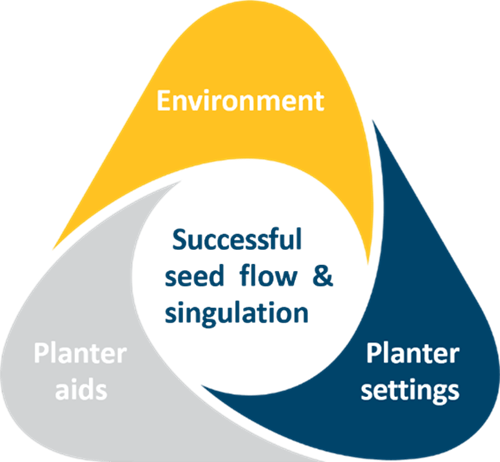
Three key management strategies for successful seed flow and singulation.
Excellent planting accuracy and plant stand establishment can be achieved with all seed sizes and shapes, regardless of seed treatment recipe and environmental conditions, through careful planter aid usage and planter adjustments.
This article highlights environmental conditions that result in challenging planting conditions, as well as best practices to optimize planting accuracy.
The challenge: Spring weather is unpredictable
Warming spring temperatures signal the beginning of the crop planting season. However, weather in spring is unpredictable with cold, dry conditions often followed closely by warm, humid conditions. Rapid fluctuations in weather can create condensation on the seed, causing poor seed flow, increased seed bridging and reduced planter accuracy.

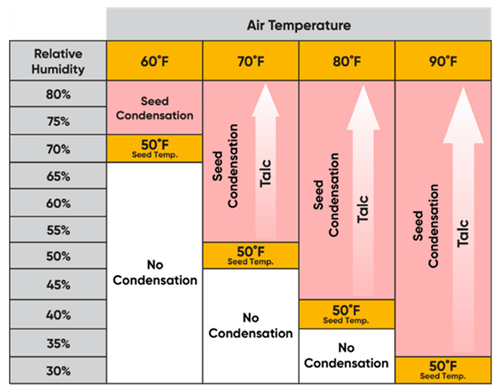
While all LumiGEN® treated seeds leave the production plant dry, when the dew point outside is above the temperature of the seed (i.e., when it is removed from cold storage into warmer, humid conditions), condensation will start to occur.
An example from the graph below, when seed is stored at 50°F, condensation can start to occur as soon as the seed is moved into warmer, more humid conditions common during the spring planting season. When condensation accumulates on seed, planting accuracy can be impacted if not managed properly.
The opportunity: Be prepared for Spring Weather
- Planter aids: Diligently and thoroughly apply planter aids as recommended by your planter manufacturer. Data has shown that priming the planter unit with graphite or a talc/graphite blend, as well as mixing the planter aid properly with the seed, can greatly improve seed flow and singulation (see details below).
a. Talc: A naturally occurring mineral that acts as a drying agent, while reducing static electricity.
b. Graphite: A crystalline carbon lubricant that helps reduce equipment wear, improves seed flow and reduces static electricity. Not a drying agent.
c. Fluency Agent: A polyethylene wax-based lubricant used to aid seed flow. Not a drying agent. - Contact your local Dairyland Seed sales representative for precise recommendations on planter settings, and access batch-specific information for individual planters. Adjust settings to planting conditions following manufacturer instructions. You can also access the following website for planter settings https://plantability.pagcat.com/. This is located on the Dairyland Seed website under “MYDS”. Scroll to the bottom of the page to find the “Dairyland Seed Plantability” option.
- Environment: Slowly increase seed storage temperature and provide increased air flow to minimize seed condensation. When using boxes or large pallets of seed bags, warming the seed should be done over numerous days (ideally, 1-2 weeks) if feasible.
For more details, click here.
Subscribe for more insights delivered straight to your inbox.